Pool Leak Detection in West Palm Beach: Why the Company You Call First Matters
September 11, 2026
Read more
South Florida's year-round swim season is tough on pool filters. Here's how often yours needs cleaning and when it's time to replace it.
Your pool filter is the most underappreciated piece of equipment on your property. It runs quietly in the background, pulling debris, contaminants, and microscopic particles out of your water every time the pump cycles. Most West Palm Beach pool owners never think about it until the water starts looking off or the pump starts working harder than it should. Blue Bubble Pools and Leak Detection serves West Palm Beach, Boca Raton, Delray Beach, Wellington, and Palm Beach Gardens with pool filter cleaning, replacement, and full equipment maintenance, and this guide covers everything you need to know about how often your filter needs attention and what happens when it does not get it.
West Palm Beach pool owners face conditions that put more demand on pool filters than homeowners in most other parts of the country.
Year-round swimming. South Florida pools run twelve months a year. There is no off-season where the filter gets a break, no winter closing that gives the system a rest. A filter that would last three seasons in a northern climate with seasonal shutdowns is working continuously here, which means the maintenance intervals that apply elsewhere often need to be shortened.
Tropical debris load. Palm fronds, bougainvillea blossoms, sea grape leaves, and the various organic debris that are part of West Palm Beach landscaping put a significantly higher load on pool filters than the grass clippings and occasional leaf that northern pools deal with. Organic matter breaks down in the water and passes through the skimmer into the filter, adding to the biological and particulate load the filter has to process.
Rainy season chemistry disruptions. From June through September, South Florida's rainy season dumps significant water into pools on a nearly daily basis. Rain dilutes chemical balance, introduces algae spores and environmental debris from the air, and creates repeated chemistry disruption that the filtration system has to work through. A filter that is already partially loaded handles these events less effectively than a clean one.
Year-round algae pressure. West Palm Beach's warm temperatures and humidity create ideal conditions for algae growth year-round. A pool filter that is overloaded cannot effectively remove the fine algae particles that pass through the skimmer, which contributes to recurring algae problems that seem chemistry-related but are actually filtration problems.
Understanding your filter type determines the specific maintenance approach and interval that applies to your pool.
Cartridge filters use pleated polyester filter elements housed inside a canister that sits at the equipment pad. Water passes through the pleated material, which traps particles as fine as 10 to 15 microns. Cartridge filters do not require backwashing, which makes them popular in water-conscious areas, and they are common in West Palm Beach residential pools.
Cleaning interval: In South Florida's year-round swim season, cartridge filters typically need cleaning every four to eight weeks. A pool with higher bather load, a heavy debris environment, or a history of algae issues needs cleaning at the shorter end of that range. A pool with lower usage and a clean surroundings can stretch toward eight weeks between cleanings.
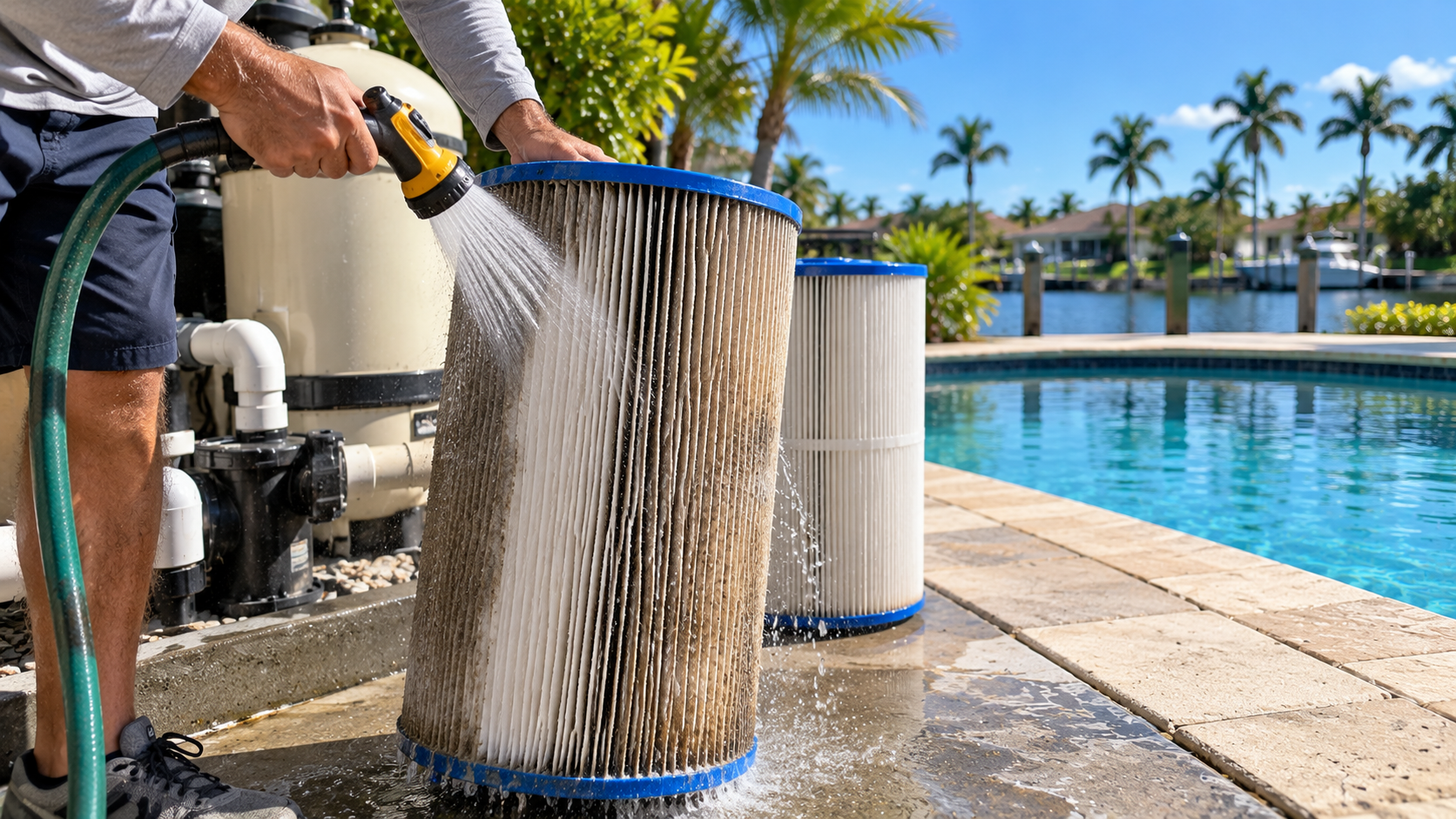
The cleaning process involves removing the cartridge, rinsing it thoroughly with a garden hose to remove loose debris, soaking it in a filter cleaning solution to break down oils and sunscreen residue, and rinsing again before reinstalling. A cartridge that is compressed and not fully restored by cleaning needs replacement.
Replacement interval: Cartridge elements typically last one to three years in South Florida's year-round environment. A cartridge that is cracked, has torn pleats, or no longer returns to full volume after cleaning needs to be replaced rather than cleaned again.
Sand filters pass pool water through a bed of filter sand or zeolite media that traps particles as fine as 20 to 40 microns. They are one of the most common filter types in older Florida residential pools and are durable and low-maintenance in terms of daily operation.
Backwashing interval: Sand filters are maintained through backwashing, which reverses the water flow to flush trapped debris out through the waste line. In West Palm Beach's year-round operation, backwashing is typically needed every two to four weeks or when the filter pressure gauge rises 8 to 10 psi above the clean starting pressure. Backwashing too frequently flushes out the debris bed that improves filtration efficiency; not backwashing enough causes channeling and reduced filtration.
Media replacement interval: The sand or zeolite media in a sand filter needs replacement every three to five years. Worn sand becomes rounded and smooth from the constant water flow, which reduces its ability to trap fine particles. A sand filter that consistently runs at higher-than-normal pressure despite regular backwashing, or that passes fine debris back into the pool, is likely due for a media replacement.
Diatomaceous earth filters use a fine powder made from fossilized diatoms as the filter media, which coats a set of internal grids. DE filters are the most effective residential filtration option, capable of trapping particles as fine as 2 to 5 microns, which is significantly finer than cartridge or sand filters. They are common in pools where water clarity is a priority.
Backwashing interval: DE filters are backwashed similarly to sand filters, with fresh DE powder added after each backwash to recoat the grids. In West Palm Beach, backwashing is typically needed every four to six weeks or when pressure rises 8 to 10 psi above the clean baseline.
Grid cleaning and replacement: DE filter grids need a full teardown cleaning once or twice a year, where the grids are removed, inspected, and cleaned individually. Grids that are torn or cracked allow DE powder and unfiltered water to pass back into the pool and need replacement. A full grid set replacement is typically needed every five to seven years with proper maintenance.
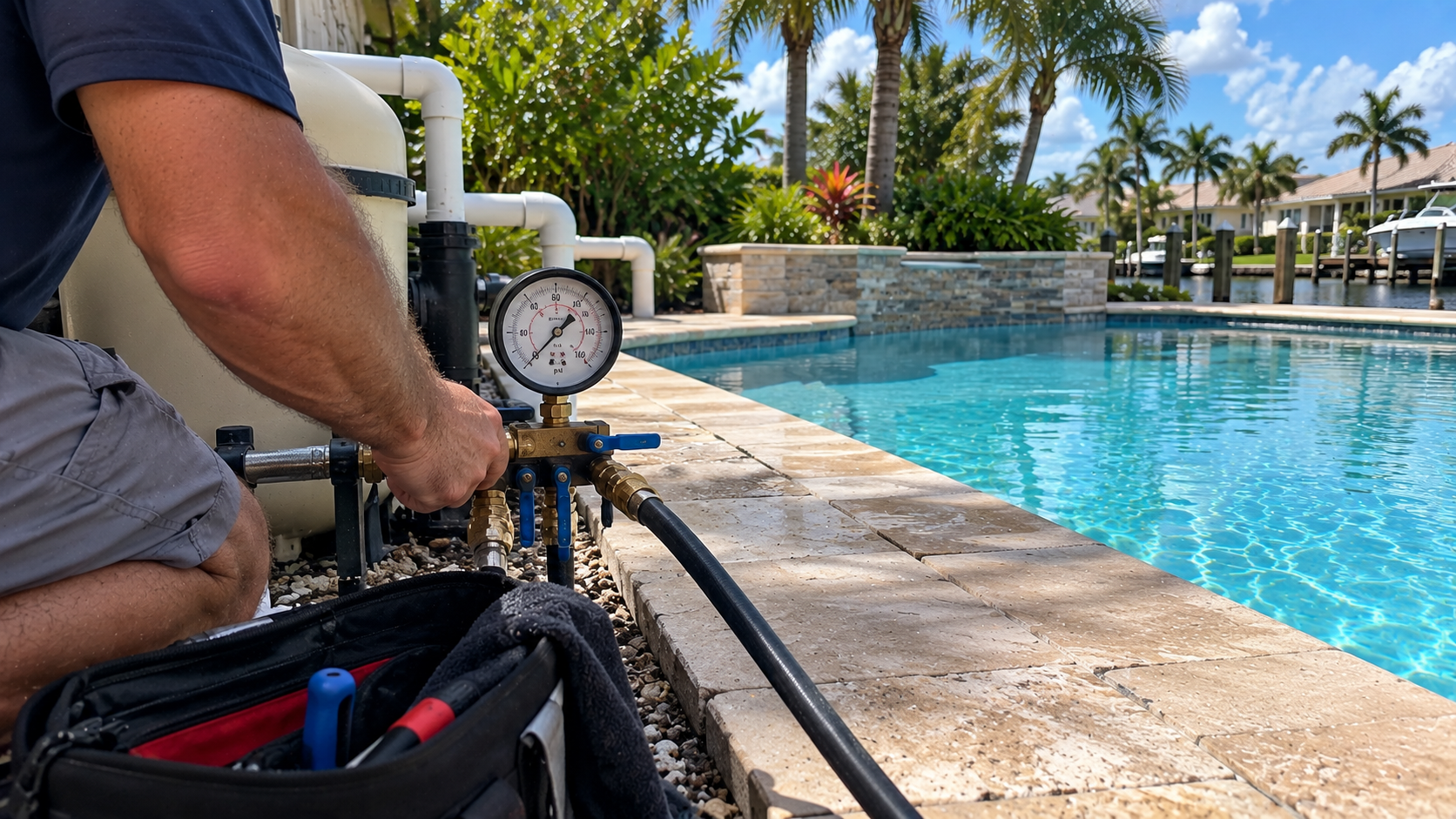
Rising filter pressure. Your filter pressure gauge is the most reliable diagnostic tool on your equipment pad. Every filter has a clean operating pressure that you should note when the filter is freshly cleaned or backwashed. When the pressure rises 8 to 10 psi above that baseline, the filter is loaded and needs cleaning or backwashing. Continuing to run a high-pressure filter strains the pump and reduces filtration effectiveness.
Cloudy or hazy water despite correct chemistry. A pool with proper chemical balance that stays consistently cloudy or hazy is usually a filtration problem rather than a chemistry problem. The filter is not removing fine particles effectively, either because it is overloaded, the media is worn, or the run time is insufficient for the pool volume.
Algae that keeps coming back. Recurring green water or persistent algae patches that return quickly after treatment often have a filtration component. An overloaded filter cannot effectively remove the fine algae particles that pass through the skimmer, allowing them to recirculate and reseed the pool after treatment.
Debris returning through the jets. Sand or DE powder returning through the return jets indicates a failed internal component. In a sand filter, this typically means a cracked lateral at the bottom of the filter. In a DE filter, it means a torn or cracked grid. Both situations require opening the filter and replacing the failed component.
Short filter cycles. A filter that reaches high pressure within a few days of being cleaned or backwashed is dealing with an unusually high load. This can indicate an algae bloom that is loading the filter rapidly, a chemistry imbalance that is causing precipitation, or a filter that has reached the end of its effective media life.
A filter cleaning visit from Blue Bubble Pools and Leak Detection covers more than just pulling out the cartridge and rinsing it.
Pressure check. We note the current operating pressure and compare it to the clean baseline to understand how loaded the filter is before we open it.
Full disassembly. The filter housing is opened and the cartridge, sand, or DE grids are removed completely for inspection and cleaning.
Thorough cleaning. Cartridges are rinsed, chemically soaked to break down oil and sunscreen accumulation, and rinsed again. DE grids are individually cleaned and inspected for tears. Sand filters are backwashed and the media is assessed for wear.
Component inspection. We inspect O-rings, tank O-rings, pressure gauge accuracy, air bleeder valves, and multiport valve or push-pull valve condition. A filter that is clean but has a failed O-ring or a sticky multiport valve is not working correctly regardless of the media condition.
Media assessment. We advise on whether the media or cartridge is still performing effectively or whether replacement is the better investment at this point.
Pressure baseline reset. After service, we note the new clean operating pressure so you have an accurate baseline for monitoring between services.
A pool filter that is working correctly supports accurate water loss assessment when a leak is suspected. A pool that is losing water to a slow leak while also running a clogged filter is harder to diagnose accurately because the system is already stressed. Before Blue Bubble Pools and Leak Detection runs a formal leak detection, we make sure the equipment is functioning correctly, which includes confirming the filter is in good working order. A properly functioning filter also protects the accuracy of pressure testing by ensuring the plumbing system is operating under normal conditions.
For cartridge filters, every four to eight weeks in South Florida's year-round swim season. For sand and DE filters, backwash when the pressure rises 8 to 10 psi above the clean baseline, which typically happens every two to six weeks depending on pool usage and debris load. Pools with higher bather load or heavy surrounding vegetation need cleaning at the shorter end of those ranges.
A cartridge that no longer returns to full volume after cleaning, has cracked end caps, torn or frayed pleating, or compressed sections that will not expand is past the point where cleaning provides meaningful benefit. In West Palm Beach's year-round swim season, most cartridges need replacement every one to two years rather than the three-year interval you might see quoted for seasonal climates.
Yes. An overloaded filter cannot effectively remove the fine algae particles that pass through the skimmer into the filtration system. Those particles recirculate back into the pool and reseed algae growth even after chemical treatment. Persistent algae that keeps returning despite correct chemical treatment often has an underlying filtration issue.
Yes. We handle filter cleaning, media replacement, cartridge replacement, and full filter unit replacement when the housing or internal components have reached the end of their service life. We also inspect and service the associated equipment including valves, O-rings, and pressure gauges as part of every filter service visit.
A pool that is running a heavily loaded filter has elevated pump pressure and abnormal flow rates that can affect how a leak presents. Before performing a formal leak detection, we confirm the equipment is functioning correctly. If we are already servicing your pool regularly, we can provide a more accurate leak assessment because we know the baseline performance of your system.
Blue Bubble Pools and Leak Detection provides filter cleaning, replacement, and full pool equipment service for residential pools throughout West Palm Beach, Boca Raton, Delray Beach, Wellington, and Palm Beach Gardens. 10+ years keeping South Florida pools clean and leak-free. Call (617) 447-8722 or request a free estimate online.